
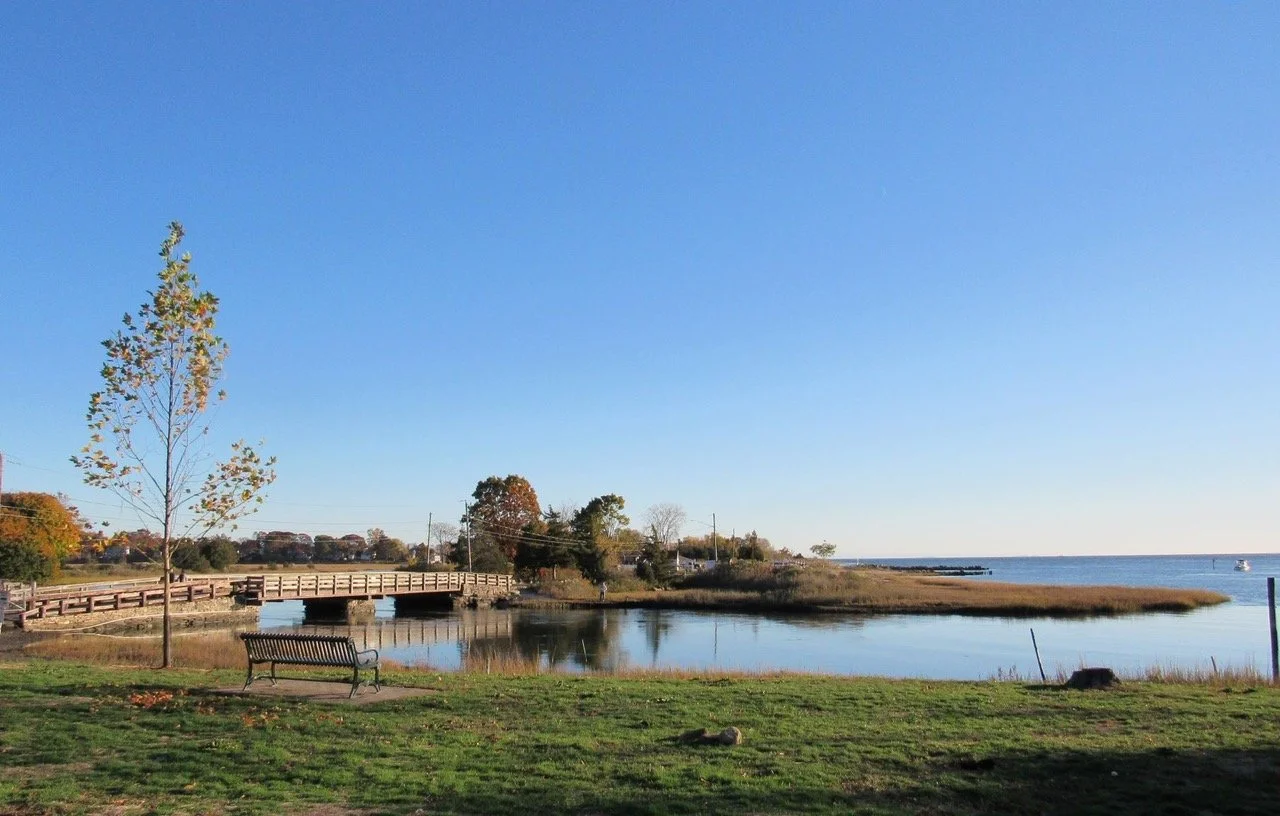
Waterside Bridge
CLINTON, CT
A Landmark that Connects Our Community with its Past
About the Waterside Bridge
Waterside Bridge has a storied history dating back to the 1600s. But it’s our own personal histories with this iconic structure that no doubt resonate most. We all have memories of sharing walks over the Bridge with the most important people in our lives: parents, children, special friends. We’ve learned how to slow down and admire the natural world as we wait for our vehicle’s turn to cross over the Bridge. It has been the backdrop in cherished photographs or a place of early morning solitude in a busy world. The Bridge is now slated for demolition in 2029 by the CT DOT, to be replaced by a $9 million two-lane “single-span superstructure supported on new semi-integral abutments supported on piles.” A large group of individuals (now nearly 200 and counting) from all over Clinton, the Shoreline, and even out-of-state have voiced their opposition to this plan.
Please consider joining us in this effort.
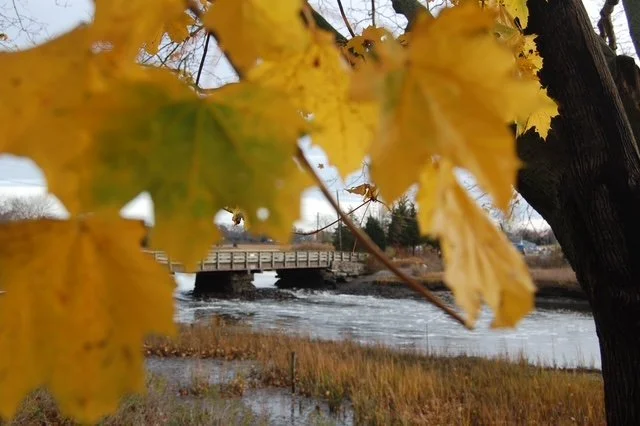
Who We Are
At first, Clinton residents most actively involved in saving Waterside Bridge lived close to it. As legally required, they had received notification of the CT DOT’s public presentation scheduled for June 4, 2026. In that meeting not only did the attendees learn the details of the project but also the fact that they only had 15 days in which to submit written comments to the CT DOT. Knowing that others in the Clinton area would be alarmed with CT DOT’s plans and would want to express their opposition as well an outreach campaign was quickly assembled. Through word of mouth, flyers placed on windshields and social media the news spread of Waterside Bridge’s imminent demise. The feedback surpassed all expectations. Over 100 individuals joined in the campaign by sending emails to the CT DOT with copies to Town Officials. To the best of our knowledge, all of this correspondence opposed the replacement of the Waterside Bridge.
Since early July, the outreach campaign’s organizers have met with six of the seven Town Council members to express concerns but also listen to our elected officials’ thoughts. The group has also been working to build an email contact list; it has consulted with a historic structures architect as well as a bridge inspector, attended Town Council meetings, written letters to newspapers, created this website, and some of the group have even been interviewed by News Channel 3 for a story about the Bridge that ran on July 27. Our goal is to continue to reach out to the community and, just as important, investigate what maintenance the bridge now requires, the costs involved, and how to fund this work without adversely impacting the Town’s bottom line. We recognize, and share in, the budgetary concerns that are on everyone’s minds. We don’t want to add to the financial burdens that we all share as taxpayers and truly believe that we won’t have to do so. There are ways to fix and finance improvements to the present Bridge. As a community, we can do this.
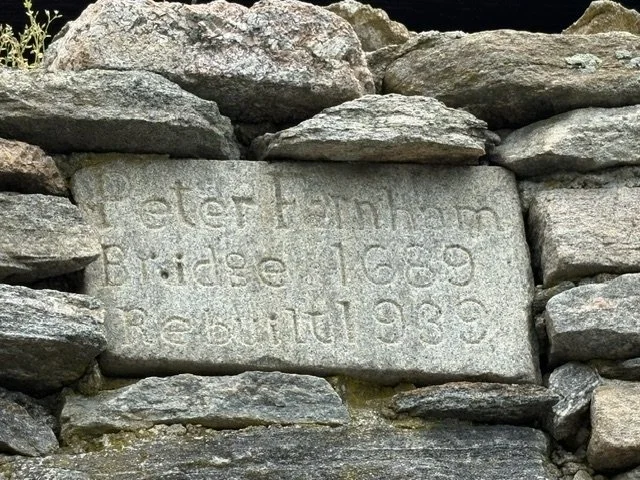
1939 Peter Farnham Bridge Stone
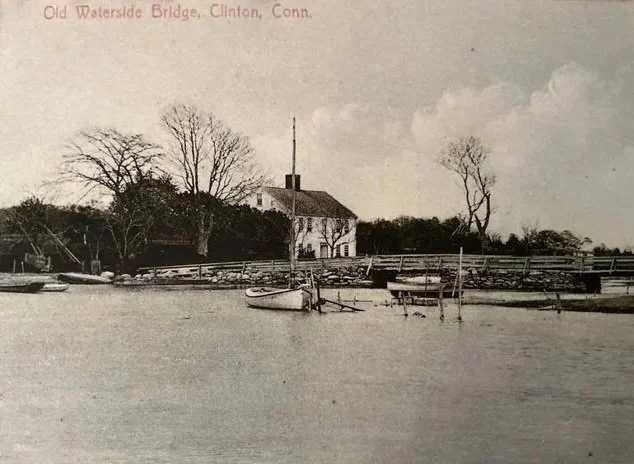
Early 20th Century Postcard
History of the Bridge
There is a stone embedded on the northwestern side of the Bridge which states that the structure’s name is actually the Peter Farnham Bridge and that it dates back to 1689. We have been unable to authenticate that date; official records indicate that the Bridge was constructed in 1697, but we do know that Peter Farnham was instrumental in making the first Bridge possible.
Clinton was originally settled in 1663, and until 1838 it was a part of Killingworth. In the late 1600s, it was a community of farmers. For these farmers, perhaps the most sought-after commodity was salt hay, which grew in abundance in the area of what is now the Town Beach. Salt hay had many uses; it was food for cattle, it was used as livestock bedding and for mulch. Salt hay filled mattresses, and it was even insulation against winter winds when piled along sills in houses. To reach the present-day Town Beach and all that salt hay, the Hammock River had to be crossed, and without a bridge, this was probably done by ox cart at low tide or with the help of a raft-type ferry. This was an era when people had a fear of the water. And it wasn’t just because most could not swim. Venturing into a body of water was often seen as tempting the devil and risking very bad luck.
According to Public Records of the Colony of Connecticut, in October 1696 application was made to the Colonial Governor for permission to build a bridge over the Hammock River by John Kelsey, William Barber, William Stephens, Robert Lane and Peter Farnham who “moved this Court in behalf of some proprietors in the Town of Killinworth (sic) that a sluice and cart bridge might be built upon the river called the Hammock River, at the charge of such persons as might be benefitted thereby.” The Court instructed the men to obtain agreement of, and support from, all who would be affected by and benefit from the project before returning to the Colonial Court in Hartford some six months later. As instructed, in May 1697, the men made the long trip back to Hartford, giving evidence of permission and support by neighboring property owners and fellow townsmen. The Colonial Governor then granted permission to build the bridge. The sluice gate was used to control the tidal flow into the marshes while the cart roadway allowed for easier access to the salt hay for harvesting.
As documented on a historical marker at the Town Beach, the Bridge had a role in local skirmishes during the War of 1812. This war was a serious and frightening conflict for Clinton residents, with large British Navy vessels frequently lurking just offshore. In 1814, warships approached Clinton Harbor. Local residents reacted quickly, armed with rifles, they ran across the Bridge and fired volleys at the enemy ships until they sailed away.
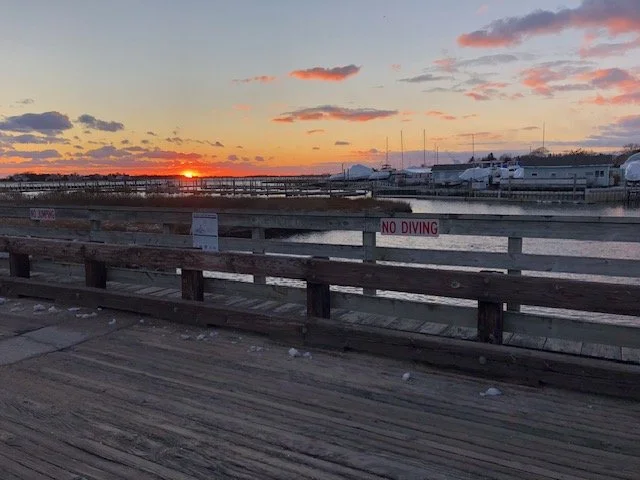
By the late 19th century farmers had become much less reliant on salt hay. We don’t know when the Town Beach area transitioned from agricultural to recreational uses but suspect it was in about the 1880s that Clinton became more of a summer holiday destination than a farming community. Rail service had made the Shoreline more accessible as had various types of sailing and steam-powered vessels. As depicted in postcards from the early 1900s, the Bridge became a scenic attraction. Note an example to the upper left which, more than 125 years ago, refers to the Bridge as the “Old Waterside Bridge.”
In September 1938, a Category 5 Hurricane decimated the Connecticut coast. The wooden decking on the Bridge was lost, but the 17th-century stone abutments and center pier remained intact. The Bridge was reconstructed in 1939, at which time the carved stone mentioned and shown above was added.
The Bridge Today
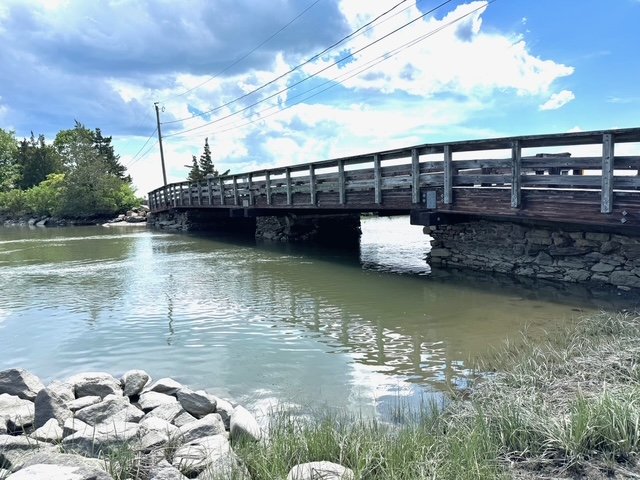
There is no official record of the many repairs that have been made to the Bridge over the centuries. But we are aware of the more recent ones, including extensive renovations that were undertaken between September 1992 and Spring 1994 when the Bridge’s substructure was rebuilt and substantially reinforced with concrete blocks serving as abutments and the center pier. Underneath are piles, which are steel poles driven deep into the bedrock. These give added stability and strength to the abutments and pier to which they are attached. This substructure is skillfully obscured by the repositioning of the 17th-century quarried stone that was originally a part of the Bridge’s abutments and pier. These stones serve no structural purpose, but their role is to appear as if they do. CT DOT will be removing all of these stones, replacing them with concrete slabs. The timber decking and railings will be removed as well and both replaced with steel. We do not know what will happen to the piles. Removing them would be an enormous and most likely unnecessary task as the piles are substantial and in all probability can be reused.
In an effort to make the new bridge more aesthetically pleasing CT DOT will be adding a faux stone facing or a textured cement to the understructure as well as some wood trim to the steel deck railings. Yet none of these features will conceal the fact that this new superstructure will strongly resemble an interstate highway bridge. As with any bridge, periodic repairs are necessary and Waterside Bridge is due for maintenance, but it does not need to be replaced, particularly with a bridge so out of sync with its surroundings. We are investigating what types of repairs the current Bridge needs, their costs, and potential funding sources.
While aesthetics and character are important reasons to save the Bridge, a far greater one is public safety. As any casual observer will conclude, it is a “pedestrian bridge that cars sometimes cross.” From the predawn hours until long after sunset, there is a steady stream of people of all ages traversing the Bridge. They travel on foot, on bicycles both motorized and not, in little red wagons, strollers, sometimes in wheelchairs and even on tricycles. With a single-lane Bridge, drivers must stop, and pedestrians always have the right of way. It is for this reason that, according to the Clinton Police Department, over the past decade there has not been a single accident on or near the Bridge. Braking at the foot of the bridge will NOT be necessary if it has two lanes. Speeding, reckless, and distracted driving are regular occurrences on Waterside. This has been a very serious problem for a very long time. It will only be exacerbated with a two-lane bridge and the widened Waterside Lane that it will require. We are extremely concerned about accidents near and on a two-lane bridge, particularly ones that may involve children.
What you can do to help save the Waterside Bridge
We welcome you to join us in preserving this important piece of Clinton’s history.
1. Stay Informed
Add your name to our mailing list for periodic updates.
2. Make Your Voice Heard
Consider contacting the Town Council, Town Manager and Town Planner to share your concerns.
Town Council Members
Carrie Allen - callen@clintonct.gov
Chris Passante - cpassante@clintonct.gov
Brian Roccapriore - broccapriore@clintonct.gov
Chris Aniskovich - caniskovich@clintonct.gov
Mike Shove - mshove@clintonct.gov
Dennis Donovan - ddonovan@clintonct.gov
Henry Teskey - hteskey@clintonct.gov
Michelle Benivegna, Town Manager - mbenivegna@clintonct.gov
Abby Piersall, Town Planner - apiersall@clintonct.gov
3. Show Your Support
Show your support and educate your neighbors with a Save the Waterside Bridge yard sign. Email us: contactus@savewatersidebridge.org
-
No, two lanes are not needed to obtain federal funding. One lane bridges receive federal funding too.
-
There are available funds from both federal and state government programs and nonprofit organizations for bridge reconstruction, restoration and repair. As an example the $8.8 million Beach Park Road Bridge project is being funded by grants secured through Ducks Unlimited.
-
That two lanes are safer than one and a widened Waterside Lane will be safer too.
The opposite is true. A wider roadway will only encourage more speeding on what is a very popular pedestrian thoroughfare where speeding and reckless driving are already serious concerns. In a letter dated July 21, 2026 the Town Manager asked that CT DOT “approve a design exemption…to allow for the construction of a one lane bridge with sidewalks on both sides.” Safety and strong community input were among the reasons for this request. We are awaiting CT DOT’s response.
-
On the Town website ( www.clintonct.gov ) is an April 10, 2025 document entitled “Waterside Lane Bridge.” In the “Existing Conditions” section is the following statement, “The current bridge dates back to 1689. Repairs were made in 1939, 1987, 1992, 2009 and 2015. However, the bridge including the supporting structure, has never been fully replaced.” This may be the rationale for replacement but it is incorrect. In 1993 the Bridge was rebuilt, a job that included substantial new piles (40 foot steel poles) driven deep into the bedrock. The other ends of the piles are embedded into two large concrete abutments and a concrete center pier, all three newly installed in 1993. The abutments and pier are faced with 17th century quarried stone which serve no purpose other than aesthetics, and to remind us of the Bridge’s historic past.
-
It was expected to last for 50-75 years. There is obvious scour (erosion) as well as loose stones in the facing near and under the water line but what is unseen is the modern substructure described in the previous answer. As with any structure exposed to water and varying weather conditions the Waterside Bridge requires routine maintenance but the substructure is substantial and doing its job.
-
Repair is the better option because it is less expensive, less time consuming, less disruptive and less labor intensive. We have consulted with a nationally known bridge inspector who also happens to frequent the Town Beach. In his decades of crossing Waterside Bridge he has had ample time to observe it. These observations, coupled with his careful study of the bridge work done in 1993 as well as recent DOT bridge inspection reports, leads him to believe that replacement is unnecessary and repair is a much better alternative.
-
Because of the modernization of the Bridge in 1993 the State Historic Preservation Office (SHPO) and CT DOT don’t recognize it as historic. This is despite the reference given above about a substantial part of its substructure being original to the 1600s. What is historic are the 17th century quarried stones that are facing for the substructure and the centuries old tradition of timber decking and railings. The Bridge abuts the Clinton Village Historic District (CVHD), which is listed on the National Register of Historic Places, and strongly contributes to the relevance, character and history of the CVHD.
-
No, there is no reason to close the Bridge. It is safe, even for vehicles weighing up to 38 tons, which surpasses the tonnage of firetrucks and emergency vehicles. Furthermore, CT DOT’s proposed work is not scheduled to begin until the Fall of 2029. There would be far more urgency if public safety were a factor.
-
The repair to scouring (erosion) and the removal of the asphalt decking. The visible scouring and loose stones are cosmetic and relatively easy to repair. Scouring below the water line is more serious but can be remedied. Most of this scouring involves the facing and not the concealed abutments. Asphalt adds considerable weight to the structure and encourages rot in wood decking. New timber decking is cheaper to install than the proposed steel decking. It also resists salt corrosion and weighs less. Waterside Bridge has always had a timber deck and railings. They have lasted for decades.
-
No, CT DOT says this will be the Town’s responsibility and that a gate is not possible with two lanes. Instead it suggests installing a gate at the booth prior to the Beach parking area but does not offer any suggestions in how to deter passengers in a vehicle at that location from going onto the Beach.
Frequently Asked Questions
News & Events
Get in Touch
Whether you have a question, an idea, or just want to say hello, feel free to reach out—we’re here to help.